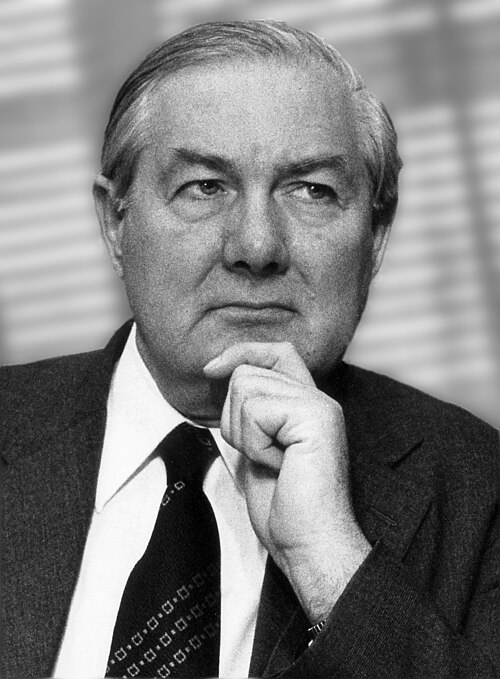
James Callaghan
TrendingQuick Facts
- Full Name
- James Callaghan
- Born
- —
- Birthplace
- —
- Age
- —
- Zodiac Sign
- —
- Height
- —
- Weight
- —
- Nationality
- 🇬🇧 United Kingdom
- Religion
- —
- Ethnicity
- —
- Eye Color
- —
- Hair Color
- —
- Profession
- Politician, Rugby Union Player, Athlete
- Net Worth
- —
- Education
- —
- Spouse
- —
- Children
- —
Last reviewed: Oct 9, 2026 · How we verify facts
Biography
a politician, from United Kingdom.
Leonard James Callaghan, Baron Callaghan of Cardiff ( KAL-ə-han; 27 March 1912 – 26 March 2005), was a British statesman who served as Prime Minister of the United Kingdom from 1976 to 1979 and Leader of the Labour Party from 1976 to 1980. Callaghan is the only person to have held all four Great Offices of State, having also served as Chancellor of the Exchequer from 1964 to 1967, Home Secretary from 1967 to 1970 and Foreign Secretary from 1974 to 1976.
He was a Member of Parliament (MP) from 1945 to 1987. Born into a working-class family in Portsmouth, Callaghan left school early and began his career as a tax inspector, before becoming a trade union official in the 1930s. He served as a lieutenant in the Royal Navy during the Second World War. He was elected to Parliament at the 1945 election, and was at that time regarded as being on the left wing of the Labour Party.
He was appointed to the Attlee government as a parliamentary secretary in 1947, and began to move increasingly towards the right wing of the Labour Party, while maintaining his reputation as a "Keeper of the Cloth Cap" – that is, seen as maintaining close ties between Labour and the trade unions.
Following Labour's defeat at the 1951 election, Callaghan increasingly became regarded as a leader of the right wing of the Labour Party, and stood for the positions of deputy leader in 1960 and for leader in 1963, but was defeated by George Brown for the former and Harold Wilson for the latter.
Following Labour's victory at the 1964 election, Wilson appointed Callaghan as Chancellor of the Exchequer; his tenure coincided with a turbulent period for the British economy, during which Callaghan had to tackle both a chronic balance of payments deficit and various speculative attacks on the pound sterling, with its exchange rate to other currencies being fixed by the Bretton Woods system.
On 18 November 1967, having initially denied that it would do so, the Government devalued the pound sterling. In the wake of the decision, Wilson moved Callaghan to the role of Home Secretary. During this time, Callaghan was responsible for overseeing the operations of the British Army to support the police in Northern Ireland, following a request from the Northern Ireland government.
Callaghan remained in the Shadow Cabinet during Labour's period in Opposition from 1970 to 1974; upon Labour's victory at the 1974 election, Wilson appointed Callaghan as Foreign Secretary. Callaghan was responsible for renegotiating the terms of Britain's membership of the European Communities (EC), and strongly supported the successful "Yes" vote campaign in the 1975 referendum, which confirmed the UK's membership of the EC.
When Wilson suddenly announced his retirement in March 1976, Callaghan defeated five other candidates to be elected Leader of the Labour Party; he was appointed Prime Minister on 5 April 1976. Labour had won a narrow majority in the House of Commons at the October 1974 election but, through by-election d
Political Career
Party Affiliation
Positions Held
member of the House of Lords
Government
member of the 49th Parliament of the United Kingdom
Government
Leader of the Opposition
Government
member of the 48th Parliament of the United Kingdom
Government
Leader of the Labour Party
Government
Prime Minister of the United Kingdom
Government
member of the 47th Parliament of the United Kingdom
Government
Secretary of State for Foreign and Commonwealth Affairs
Government
member of the 46th Parliament of the United Kingdom
Government
Shadow Foreign Secretary
Government
Shadow Secretary of State for Employment
Government
Shadow Home Secretary
Government
member of the 45th Parliament of the United Kingdom
Government
Home Secretary
Government
member of the 44th Parliament of the United Kingdom
Government
Chancellor of the Exchequer
Government
member of the 43rd Parliament of the United Kingdom
Government
Shadow Chancellor of the Exchequer
Government
member of the 42nd Parliament of the United Kingdom
Government
member of the 41st Parliament of the United Kingdom
Government
Frequently Asked Questions
Related People


Embed James Callaghan's Profile Card
Add this widget to your website or blog with a single line of code.
<div id="fg-widget-james-callaghan"></div>
<script src="https://famegraph.com/api/widget/person/james-callaghan?format=js&theme=light"></script>